
The Crossley Heath School
From Crossley Heath to Centre Court: Rob’s Journey Through Tennis Officiating
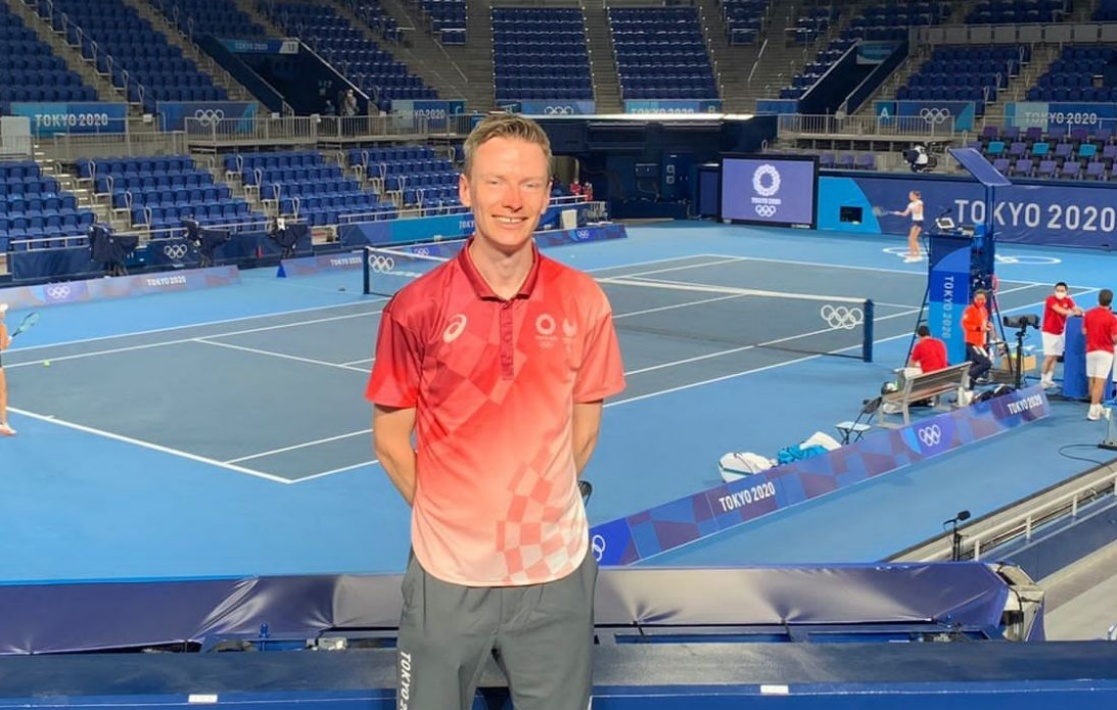
Rob’s journey into international tennis began at just six years old, playing on the public courts at Wellholme Park in Brighouse. From there, his love of the game grew steadily, competing in local Calderdale leagues and going on to represent West Yorkshire at the Millennium Youth Games in Southampton in 2000. At Crossley Heath, tennis was part of summer PE lessons, although there was no formal school team at the time. Like many young players, Rob simply enjoyed playing the sport, and a career in officiating was not something he had ever considered. “Officiating had never been a consideration for me at all. I enjoyed playing tennis and that was it.”
That changed thanks to an unexpected opportunity. As a teenager, Rob received a letter from the Lawn Tennis Association inviting ranked players aged 16 to 18 to consider officiating. The possibility of working at Wimbledon was enough to spark his interest. “I had been to Wimbledon as a spectator once and thought it would be pretty cool to work there.”
After attending a training course in Newcastle, Rob progressed through the officiating pathway, starting out as a Line Umpire. Although A-Levels delayed his first opportunity, he made his Wimbledon debut in 2006 and has returned every year since. Over time, he trained as a Chair Umpire and steadily built his experience. Since 2017, he has worked exclusively as a Chair Umpire at the highest level of the sport.
For anyone considering officiating, Rob is clear about what matters most. Passion is key, especially in the early stages when officials are working their way up through smaller tournaments across the UK. “You need to really have a passion for the sport when you start, because you need that to motivate you to build up your experience.” Strong communication skills are equally important. “A good decision communicated badly can lead to a worse outcome than a poor decision communicated well.”
Rob’s career has taken him to the very top of the game. He has officiated at all four Grand Slam tournaments and, since 2014, has not missed a single one. Each offers a completely different experience. The Australian Open has a relaxed, festival-like atmosphere, Roland Garros is steeped in tradition with incredibly passionate crowds, and the US Open is vibrant, loud and full of energy. Wimbledon, however, remains particularly special. “The feeling of walking through the gates there every year is still a special one.” Beyond the Grand Slams, Rob has also officiated at multiple Olympic Games, from London 2012 through to Paris 2024. Representing his country on such a stage is something he describes as truly unique. “It is a really special feeling working at an Olympic Games because you are representing your country.”
Across his career, there have been many standout moments. Rob has officiated three Wimbledon doubles finals and two Ladies’ singles semi-finals, as well as matches on some of the most iconic courts in the world, including Centre Court, Philippe Chatrier, Rod Laver Arena and Arthur Ashe Stadium. Achievements he never imagined when he first started out.
Handling pressure is a constant part of the role, and something Rob has learned to manage carefully. A big part of that is preparation before he even steps onto the court. “You go into the matches knowing there will be pressure, so you can pre-condition yourself before stepping onto the court.” He does this by visualising different match scenarios in advance, as well as the atmosphere of a full stadium, so that nothing feels unfamiliar when the match begins. “I tend to visualise match situations that could happen, and then if they do happen, I can react in a calmer and more composed manner.” This approach allows him to treat even the biggest matches like any other. “You have to tell yourself that it is just another match and treat it like all of the others.”
Like any career at the elite level, there are challenges. Long periods away from home, constant travel and the demands of international schedules can be tough. Weeks can pass in a cycle of airports, hotels and tennis courts, often missing time with friends and family. However, the rewards are just as significant. Through his work, Rob has travelled to 41 countries and visited some of the world’s most iconic landmarks, from the Great Barrier Reef and the Great Wall of China to the Pyramids of Giza and the Empire State Building. “You get to see so much of the world that you would not ordinarily have seen.”
For current students, Rob’s message is clear. A career in sport does not have to mean becoming a professional athlete. There are countless roles behind the scenes, from officiating and journalism to marketing, administration and sports science. “Only a handful of people ever make it as a professional athlete, but there are many ways to stay involved in the sport you love.” When you are younger, it is easy to focus only on the players on the court. But as Rob’s journey shows, there is a whole world of opportunity beyond that, waiting to be explored!
The Crossley Heath School